Why This Is the Moment Everything Starts to Change for Pancreatic Cancer
For forty years, progress against pancreatic cancer crawled. This year, several breakthroughs arrived at once - and together they point to a future we have been waiting for. Here is why that future depends on research.
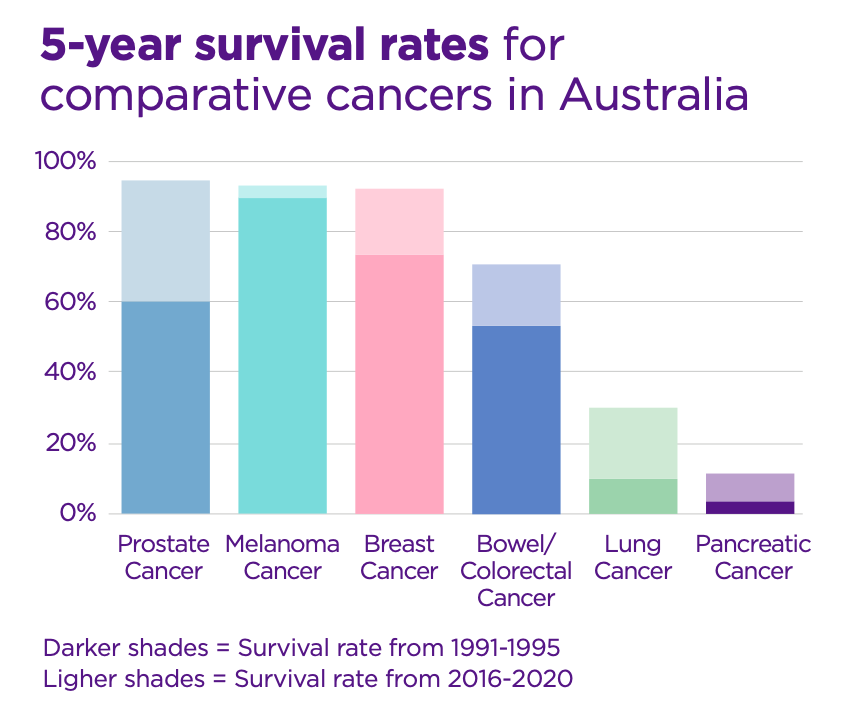
Pancreatic cancer has long been the one that barely moved. While survival for many other cancers climbed decade after decade, pancreatic cancer stayed stubbornly low ( see graph below) In Australia today, fewer than 1 in 7 people diagnosed will survive five years.
So when something shifts, it is worth paying attention. And in 2026, something shifted - not in one place, but in several at once.
At the world’s largest cancer conference this year, a clear pattern emerged. For the first time, the biggest advances were not only about treating cancer better once it is found. They were about three things beginning to happen together: finding cancer earlier, understanding it more deeply, and treating it more precisely. Put simply - detect earlier, understand deeper, treat smarter.
Here is what that means for a disease like pancreatic cancer, and why it adds up to a genuine turning point.
Treat smarter: the “undruggable” target finally hit
For nearly forty years, more than nine in ten pancreatic cancers have been driven by the same faulty gene - KRAS - and for just as long, that fault was considered impossible to switch off with medicine. This year, a new tablet called daraxonrasib did exactly that, nearly doubling survival in people whose cancer had returned after chemotherapy. (We have written about that breakthrough in detail separately.) It is not a cure, but it is proof of something researchers have chased for decades: pancreatic cancer’s central engine can be targeted - and targeting it helps people live longer.
Understand deeper: turning the body’s own defences on the cancer
Two other approaches are moving from the laboratory toward the clinic. The first uses the body’s own immune system. Treatments that re-train a patient’s immune cells to recognise cancer - already transforming the outlook for some blood cancers - are now being carefully tested against solid tumours, including pancreatic cancer.
The second is cancer vaccines. Not vaccines to prevent cancer, but vaccines that teach the immune system to attack a cancer that is already there - including the KRAS fault itself. In early trials, researchers have shown that pancreatic cancer vaccines can generate measurable immune responses in patients.
The strongest evidence comes from very small studies of personalised mRNA pancreatic cancer vaccines. Some studies have shown immune responses in roughly half of participants, others higher depending on how response is measured.
These are still early days, and not yet treatments anyone can ask for. But a few years ago they were only ideas. Now they are being tested in real patients - and that is how every breakthrough begins.
Detect earlier: the part that matters most for pancreatic cancer
This is the one that could change the picture most of all. Pancreatic cancer is so deadly largely because it is usually found late, once it has already spread and treatment is hardest. And there is currently no screening test for it - nothing like the mammogram for breast cancer, or the bowel-screening kit sent out in the post.
This year brought the largest trial ever run of a blood test designed to spot many different cancers early from a single sample - the NHS-Galleri trial in England, involving more than 142,000 people. We need to be honest about the result: it did not meet its main goal, and experts have rightly said it is not ready to be rolled out as a screening program. But it did shift cancers toward being caught earlier, and it picked up cancers that usually have no way of being found in time.
That is why ASCO’s chief medical officer, while careful about the limits, said the findings still offer real hope for deadly cancers that currently have no screening at all - and she named pancreatic cancer specifically. For us, that is the honest and powerful point. Not that early detection is solved - it is not - but that for a cancer like ours, with no screening to speak of, this is the first real signal that one day there could be.
Why this is a turning point
None of these is a finished answer. But step back, and the shape of the future ( HOPE) is suddenly visible: a world where pancreatic cancer is found earlier, understood more precisely, and treated more effectively than ever before. After decades of being told this was the cancer that would not budge, that is a profound change - and it is beginning now.
And this is exactly why research funding matters
Here is the part we most want you to take away.
Every one of these advances - the new tablet, the immune therapies, the early-detection blood test - exists because someone funded the research behind it, often years before anyone knew it would work. Breakthroughs do not appear from nowhere. They are built, slowly, by scientists who are given the time, the equipment and the support to keep going.
That is where Dare to Hope comes in. We are an Australian, volunteer-led charity, and 93 cents of every dollar we raise goes directly to pancreatic cancer research. We currently fund two early-career researchers - Dr Michael Lee at the Peter MacCallum Cancer Centre and Dr Matteo Golo at the Garvan Institute - and we are working to establish a third. These are exactly the kind of talented young scientists who, without dedicated funding, are too often forced to leave the field - taking years of hard-won expertise, and the next potential breakthrough, with them.
The lesson of 2026 is simple: research works. Given enough of it, even the “impossible” targets fall. The reason pancreatic cancer has lagged behind is not that it cannot be changed - it is that it has been under-researched and under-funded for far too long. That is what we exist to change.
Progress is finally arriving. With your support, more of it can arrive here, sooner, for Australian families.
Together, we’re changing the numbers.