Update: A daraxonrasib trial is opening in Australia - for patients not yet treated with chemotherapy
A new way for some Australians to access this treatment sooner, through a clinical trial.
Since we published our explainer on daraxonrasib - the new treatment that nearly doubled survival in advanced pancreatic cancer - there has been an encouraging development closer to home.
The Jreissati Pancreatic Centre at Epworth is preparing to open a clinical trial of daraxonrasib in Australia, expected to begin in July 2026, with sites at Epworth Richmond, Epworth Freemasons and Epworth Eastern.
There is one important difference to understand. Our earlier article was about daraxonrasib in the second-line setting - people whose cancer had already been treated with chemotherapy. This new trial, called RASolute 303, is a first-line study. It is for people with metastatic pancreatic cancer who have not yet received treatment for their advanced disease. In other words, the two studies are looking at different groups of patients, at different points in their treatment.
In the trial, daraxonrasib (given with or without chemotherapy) is being compared with standard chemotherapy alone. Testing the drug earlier, before other treatment, is exactly where researchers hope the benefit could prove greater still.
For Australian families, this matters for a simple reason: a clinical trial can be one of the few ways to access a promising new treatment before it is formally approved and available. Taking part in a trial is a significant decision, with its own considerations, and it is not the right path for everyone - but for many, especially for the outcomes we’ve already seen with this drug - it is definitely an option worth exploring.
As with any treatment decision, the right first step is a conversation with your treating oncologist, who can advise on your situation and whether this trial may be suitable. Eligibility for any trial is decided case by case against strict criteria.
Families and clinicians seeking more information about the study can contact the research trials team at the Jreissati Pancreatic Centre at Epworth directly, or read the centre’s own announcement on its website.
We share this because we believe Australians affected by pancreatic cancer deserve to know, as soon as possible, about every avenue of hope opening up - and because progress like this is exactly what research makes possible.
And for those already in treatment
This new trial of RASolute 303 is for people who have not yet been treated for their advanced pancreatic cancer. But there is encouraging news for the other group too. Discussions are underway to bring an additional avenue to Australia - through what is known as an “expanded access” program - for people who have already started treatment for their pancreatic cancer.
Expanded access is a pathway that can allow patients to receive a promising new treatment outside of a formal clinical trial. This relates to the previously-treated setting - the same group of patients studied in the original RASolute 302 trial, whose results we shared in our explainer. Nothing is confirmed yet, but we will keep spreading the news as soon as we can.
To be among the first to know, subscribe to our newsletter, follow us on social media, and keep an eye on our website for updates.
We share this because we believe Australians affected by pancreatic cancer deserve to know, as soon as possible, about every avenue of hope opening up - and because progress like this is exactly what research makes possible.
“Do I need private health insurance to take part?”
This is a common and important question, because Epworth is a private hospital. As a general rule, taking part in a clinical trial is decided on medical eligibility — not on whether you have private health insurance, and not on whether you are a public or private patient. The costs directly related to a trial, including the investigational drug, are typically covered by the trial, rather than by the participant.
That said, arrangements differ from trial to trial, and some standard costs can still apply. We are not able to advise on what any individual would or would not pay. The only reliable source for this is the trial team at the Jreissati Pancreatic Centre at Epworth, who can explain exactly what is covered and whether there would be any out-of-pocket costs. We would encourage anyone considering the trial to ask them directly, and to talk it through with their treating oncologist or GP.
Together, we’re changing the numbers.
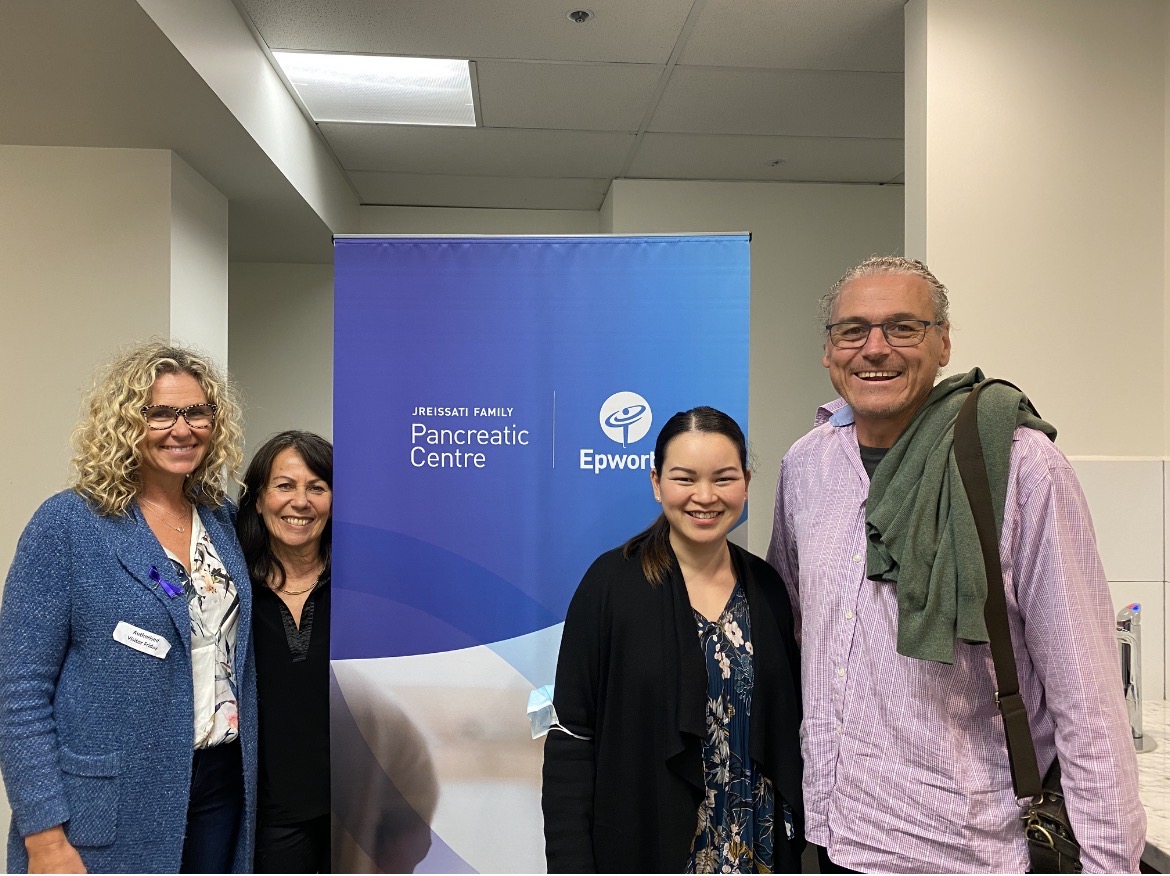
Cherie, Jo Crowther, Caroline Le, Paul Dear - March 2021
A personal reflection from Cherie Dear
Paul and I reached out to the Jreissati Pancreatic Centre at Epworth in March 2021. We were so excited that a centre specifically focused on Pancreatic Cancer was opening in Melbourne. We were very grateful to Elias and Colleen Jreissati who had made the donation that made opening the Centre possible. Paul had already started his treatment at another hospital closer to home but we kept in very close contact with their original (very) supportive care Nurse Jo Crowther and the JPCE Research Program Manager/Deputy Director, Caroline Le (now Project Director- Research Strategy- Epworth).
We stayed with our treating hospital closer to home because there weren’t any trials available that Paul would be eligible for, but I kept in close contact with JPCE, always checking to see if there was anything new that Paul could benefit from. Unfortunately for Paul, there wasn’t.
Today brings very mixed emotions for me. I am so pleased to see this progress happening and to see it being brought to our home town of Melbourne. I am so grateful for the donation of the Jreissati family that made the Centre possible, and the foresight and the work of the JPCE since establishment. I am so happy to see Paul’s face again in this photo of us with Caroline and Jo, but it makes me so sad that he did not survive long enough to be able to benefit from these sorts of breakthroughs.
But I am proud of the work that we continue to do in his name to help fund the research that makes these breakthroughs possible. Today I’m thinking of all the families like us whose people didn’t make it in time to benefit, all the people currently living with pancreatic cancer and the HOPE that information like this brings, but also the stress it can generate to try to get access and be one of the lucky ones who can take part when Clinical Trials become available.
Paul did not live to see this day. But every breakthrough we help fund turns hope into something real - into time, into options, into another chance for someone who otherwise would have had none. Paul never gave up until the very end - hanging in for the change that might give him an opportunity to participate in a treatment, that would be life extending - like Daraxonrasib will for many. That is why we keep going.
Together, we’re changing the numbers.
— Cherie

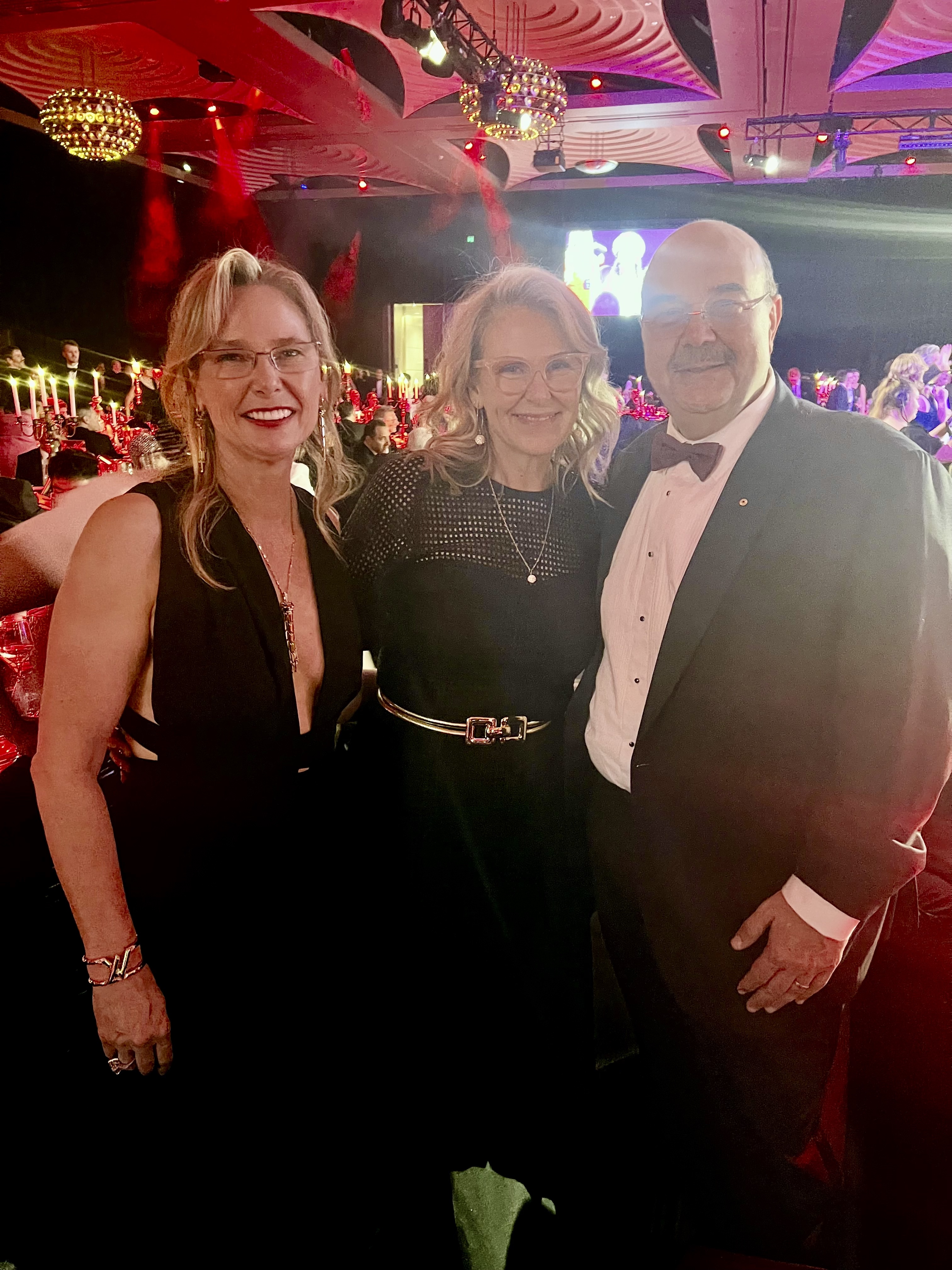
Jo Crowther, Caroline Le, Cherie Dear - Epworth Gala Ball